Thursday, April 30, 2009
And We Are Off!


Friday, April 17, 2009
Sign Your Donor Card!
 I was involved in transplant surgery this past weekend, a surgery led by Dr. Joe. This is the second transplant surgery I have been involved with but the first time I’ve dealt with a scenario where there has been one donor and many recipients. I have mixed feelings now, after the procedure: sadness for the donor but happiness for all of those who benefitted.
Part of my role on the transplant team was to escort the donor to the procedure on that fateful Good Friday morning. (Well, it was a “good” Friday for some; not the donor!) It was eerie knowing that I was the last to have a conversation with the donor before Dr. Joe began. I found it odd that the donor willingly proceeded to the site of termination. I questioned the ethics of assisting in the act that would end a life even though I knew that the death would save many. I could intervene and save the donors life, but at what cost? Is terminal really terminal? What if a treatment was found and the effects of time could be reversed? Would the death of one on Good Friday really save the lives of others? If so, how many would benefit? Could such matters be reduced it a “score card” type of evaluation?
With the donor immobilized and then terminated, Dr. Joe began to remove the heart. I had the honour of helping by removing many other vital organs. Even some cosmetic donations were made. It took only a few hours to take the donor from fully functioning, albeit worn out, to a stripped-out shell. This was the saddest part for me. I hate to think that we are only a few boxes of good parts in an aging, decaying case.
But with death comes life! A younger recipient with a bad heart now has a new heart, (new to them at least) and the opportunity to live again after years of convalescing. To see her come to life again, reborn , and leave the surgery under her own power was very rewarding. But the death of one on Good Friday meant life for not just one but many by Sunday. A new heart for one, yes, but a new front end for another and a new brain for a third and boxes of hope for many more yet to be touched by Friday’s Sacrifice.

Thanks to Dr. Joe for giving life to our newest and best-looking shiny blue firefly, for fortifying the front end on my dear old friend and driving partner (515,000 km and still going), and for adding a new CPU to Heather’s pride and joy. My shelf of pretty-good parts is also growing, and has inspired me to begin planning a little cosmetic surgery on my old girl.
 Sign your donor card, and you, too, can bring life where only death looks likely. Remember those who have made sacrifices for us, and always be nice to your mechanic!
Saturday, January 3, 2009
Washing Over My Soul
 This is the time of year for joy and peace, but, for me, it is also a time of reflection. The world is full of moments of tragedy and triumph, both natural and man-made in origin. Each of these events resonates with us differently, and, I believe, each event shapes us to some degree. I cannot explain why the tsunami of December 26, 2004 impacted me so much at the time, and I could not imagine how it would change my life--land locked as I was in central Alberta--but it did! Because of the tsunami, I met Eric Rajah and A Better World, I realized that I needed to involve the very talented people I know in humanitarian endeavours, and, most importantly, I recognized the importance of creating opportunities for our students to see the real world! It was as though that wave had washed over my soul.
Lessons Learned


Ours was the second team from ADRA (the Adventist Development and Relief Agency) to reach Sri Lanka; a medical team had been in the area before us. Pictures can never fully capture the experience of being on-site, so, in spite of my reviewing many photos prior to the trip, I was not ready for what I saw upon arrival in Pottuvil. When we reached the coast, the extent of the devastation was readily apparent, and there had already been two months of cleanup. I ran on pure adrenaline for the first three days. My mood ran from complete despair through admiration to optimism. I learned a few valuable lessons on that trip:
- Nothing good can happen if you do not have good local people on the ground.
- Not everyone is good.
- Follow the money.
- Leave your preconceived solutions at the airport.
- Listen.
- Make a difference one person at a time.
- The road to hell is paved with good intentions!
There is no question that I saw many examples of greed, corruption and profiteering, but I also saw many examples of giving, caring and personal sacrifice. The trick to helping is to always work with people exhibiting characteristics of the latter group.
One From the Latter Group
 On one occasion, two of us were busily building doors to stop the monkeys from stealing the offerings at local shrine when a man brought us a melon. He spoke almost no English, and we couldn’t even identify the language that he was speaking, but I’m sure he was basically saying, “Take a break you crazy white guys. Don’t you know it is the hottest part of the day? We don’t need two dehydrated old men passing out on us; we have enough to deal with right now!” Sagara helped us for the rest of the day.
 At the end of the day we learned that Sagara had aquired a simple machine and was attempting to make cinder blocks, one at a time, to support his family and to help rebuild his community. Sagara was a laborer who had lost everything but his family—a family that grew by one on the day of the tsunami as his wife gave birth amidst the chaos. Now, they were all living in a tent in his mother-in-law’s yard. My mind started whirring, plotting, and planning. After doing a quick needs-assessment, asking many questions of many local people, and, most importantly, listening carefully to their answers, our group discussed the idea of supporting Sagara so he could increase cinder block production.
 Sagara had asked for nothing. He had given freely of himself. He was not aware of our plan when he arrived for a meeting at his neighbours house. We simply started asking questions of Sagara with the help of a translator, and, after four hours of talking, had a plan that would see him triple his production, employing 12 local labourers. As a bonus, Sagara would be now be producing “Super Blocks” because I passed on what I had learned from Sandy R. in Mech 269 when I was a student at Old College. (It still amazes me how misunderstood concrete is, but that is the topic for a duller blog.)
I went back to Sri Lanka some months later to see if what we had started had gone anywhere and to start more projects if the people we chose during our first trip proved to be the right people with whom to work. The change in the area was amazing. The results of international aid were evident everywhere--some positive and some negative. Buildings were going up all over, damage had been cleaned up, and many people were far better off than before the tsunami. Unfortunately, not everyone was so lucky.
Of Locals and Labour
The best example of aid damaging the local economy involved the rice farmers. Most of the rice crop had been harvested before the disaster struck, but huge amounts of rice flooded into the country from abroad. The media carried footage of people without enough to eat so well-intentioned but misguided foreign agencies did what seemed right—they sent food. But the effect of that food hitting the market was that the price of rice was cut in half while the price of labour doubled. Aid agencies paid more double the going rate for labor, so those who would normally work for a local rice farmer were intisted into taking jabs in construction, and the rice crop for the following year was reduced drastically. Some local farmers lost their farms. In time, the markets sorted themselves out, but in the short run many suffered not from the wave but from the good intentions of other countries. The moral of the story is: if something is needed, buy it locally if you can!
Did we back the right horses? Mostly, yes. We had wells drilled that were producing clean water for residents of newly constructed communities—a very important project and a huge success! Some of the political relationships we had to cultivate produced less bang for the buck, so we minimized our exposure on those fronts. But overall our involvement was a success.
Changing Lives
For me, the greatest success was Sagara. When I returned, he was producing blocks—and lots of them! He was filling orders of 80,000 blocks, 3 blocks at a time. Still, the success was not in those numbers but in Sagara himself. Upon my return, Sagara was still living in a tent and a grass shack. When I asked him why, as a mason and block maker, he had not built himself a house like all his neighbours had, he replied, “I will build my house, but right now my country needs me to make blocks.” He was providing employment for his countrymen, producing a much-needed local product with local technology, and supporting his community by donating bricks for school projects. His loan repayment funded six small agricultural projects which helped some very poor families to get back on their feet.

For Sagara and I, this wave washed away the silt that clouded our souls, letting both of us see more clearly what is truly important.
Wednesday, October 1, 2008
Bolivia or Bust

In May of 2009, Olds College and A Better World (ABW) will take students and community members to Bolivia for two weeks. I will be leading this trip and in so doing will realize a dream five years in the making. After Katrina, Olds College and ABW partnered to send a group of students, staff and teachers to the USA to help rebuild homes. Each student returned with new insights into the world in which they live. I know by experience that a trip to Bolivia will have the same result but multiplied by 10! I know by experience that this will be a life-altering experience for some of the people in our group and still very impactful for the rest.

Mountains in Bolivia
I do have concerns and a little trepidation: all developing countries are unstable, all have unique health and cultural challenges, and all have safety issues (usually the traffic is the worst). I am encouraged by the fact that we have some very fine people in Bolivia to help. Marg and Jake Hoogland moved to Bolivia from Canada about three years ago; Zenon Flores is a local agriculture instructor with a passion for his field; and Maria Jose is the director of CERINID, a local home for street boys. And I hope that my experience in the country will prove beneficial as I lead the trip. I have been to Bolivia twice myself, and ABW has completed two very successful trips there in the last two years.

Jake and Marg Hoogland
This trip will focus on the state of agriculture in Bolivia, as well as helping to make CERINID more self sufficient in terms of food production. We will remain in the Santa Cruz area, but see developed farming areas, homesteading areas, mountains and jungle. We will be working on a local farm to help set up a dormitory that will be used to house students that will take agriculture apprenticeship training with Zenon Flores.

Zenon Flores and a Golden Aguoti Boar
So, here goes a new journey for me and a great opportunity for students and others in the community. Let’s hope this time I don’t need to use my GPS coordinates for the coffin store! Stay tuned for more details, and follow along on this blog in May to read about the adventure.
Gordon Gilchrist
Technical coordinator
A Better World
Instructor
Olds College
ggilchrist@oldscollege.ca
Blogs:
http://gordonatabw.blogspot.com/
http://gordatoldscollege.blogspot.com/
Friday, September 19, 2008
It is Not All Laughing Children and Happy Endings
The Rural Health fund was established by ABW to be administered by Marg and Jake. Having a Canadian couple living in the community insures that the people who are truly in need of help can get it, and reduces the chances of waste and corruption. This fund is to help with testing and treatments of conditions past what the local clinics can deal with.
Earlier this year Marg contacted me about a little boy in their community that was not responding to local treatments, and slowly going down hill. His name was Jhonny, and he was 10 years olds. He was smart and a leader in his family, and at school. He was all boy, climbing trees, running fast, and coercing his sibling into trying to keep up. When Jhonny did not show up at a community function, Marg became concerned. She went to see Jhonny and he was in a very poor state. Not walking, dehydrated, and with bad headaches. The family had taken him to the local clinic again very recently, and he was giving Milk of Magnesia.
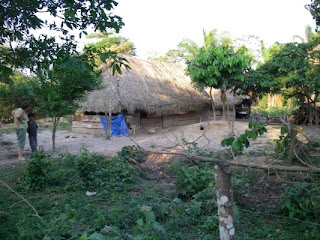
Jhonny's House
Marg contacted me and suggested that this would be the first case for the ABW rural health fund. I agreed, and the Hooglands dropped what they were doing and took Jhonny and his mother to the children’s hospital in Santa Cruz. This was the beginning of a 6 week stay for Jhonny, his mother (8 months pregnant), and Marg. You see, Jhonny had a brain tumor, a big brain tumor. It was determined that the tumor was operable if there was money to cover the bills… There was no question that this tumor would be fatal and probable soon. Marg and I had the conversation about draining the entire health fund on one little boy, instead of helping 25 people in the community. These are judgment calls that have to happen in a country like Bolivia, and that is the sad part. My cousin’s youngest son had a brain tumor, operable, and at no point did anyone say “should we sped the money, or just let him die”.

Marg and Jhonny in the Childrens Hospital
This was a no brainer for me! Spend the money and give the kid a chance! Jhonny ended up having 6 surgeries in 6 weeks, and contracted chicken pocks to boot! The total hospital bill was around $5,000.00.
I flew to Bolivia in August to start arrangements for a group trip in May 09. On my first day in Bolivia Marg and Jake took me to see Jhonny in the hospital. They were hiring someone to be with Jhonny at night as Marg and Jake were coming with me. Jhonny had his bandages off for the first time and was looking thin, but responsive. He was squeezing a tube of toothpaste, and his eyes would flutter open. He responded to touch on his feet, and the doctors were very hopeful about his condition.

Jhonny's mom Erselia and Marg
We left the hospital to get some food and talk about the busy week to come. Marg received a call to return to the hospital. Turns out the Jhonnys heart stopped, and he died. Six operations and chicken pock were just too much for his little body. Death in a tropical country leads to its own set of problems. We returned to the hospital to have the body released. This meant paying the bill in full, and getting the forms to transport Jhonnys body. A coffin would be about 600 B ($95.00 Can) and Jhonnys mother said she just couldn’t afford that, so we would just wrap him in a blanket and put him in the back of the truck…. Not if I can help it, I thought. It turns out there are all night coffin stores near the hospital, so off Jake and I went.
After a long terrifying drive in the middle of the night, we lay Jhonny in his coffin on the alter of the local church for a day of service before the burial. Jake and I went to his house to get a little sleep before to burial. 51 hours had past since I had seen a bed, and that one had been in Canada. 51 hours that remolded who I am, and clarified why I try. Jhonnys mother was very upset that we spent all this money, and Jhonny died anyway. She felt badly and was concerned that we wasted all that money. She was devastated by Jhonnys passing, but was worried we would think we wasted the money. Wasted the money??? That somehow she had let the donors down, because Jhonny died???

Carrying Jhonny to the graveyard
I have replayed this over and over in my mind since returning to Canada. This was an operable, benign tumor in the head of a 10 year old boy. How could we not give this boy a chance? If this was your son, would you say, “sorry, too much money” and let him die? No, of course not. This family did not have the money (about 2 years wages for them) and I am not a big believer in throwing cash at problems, but this is the perfect example of where money is all that was needed to give Jhonny a chance because we had Marg and Jake on the ground willing to help.
We do not win them all, but that should not deter us from trying. You cannot win if you don’t try. I know we like to read stories about happily ever after, but there is much to be learned from the journey as well. We tried, and I would try again given the same circumstance. The rural Bolivia fund is now empty, and I would like to double it for next year. Please consider supporting this activity, we are very lucky to have Marg and Jake on the ground to administer this fund. I don’t think you could get better bang for your buck anywhere else.
For more information on Jhonny or the Hooglands see
http://www.hooglandsinbolivia.blogspot.com/
To donate, follow the link below, and please specify Rural Bolivia,Thanks!
http://www.a-better-world.ca/
Gordon Gilchrist
Technical coordinator
A Better World
Instructor
Olds College
ggilchrist@oldscollege.ca
Blogs:
http://gordonatabw.blogspot.com/
http://gordatoldscollege.blogspot.com/